
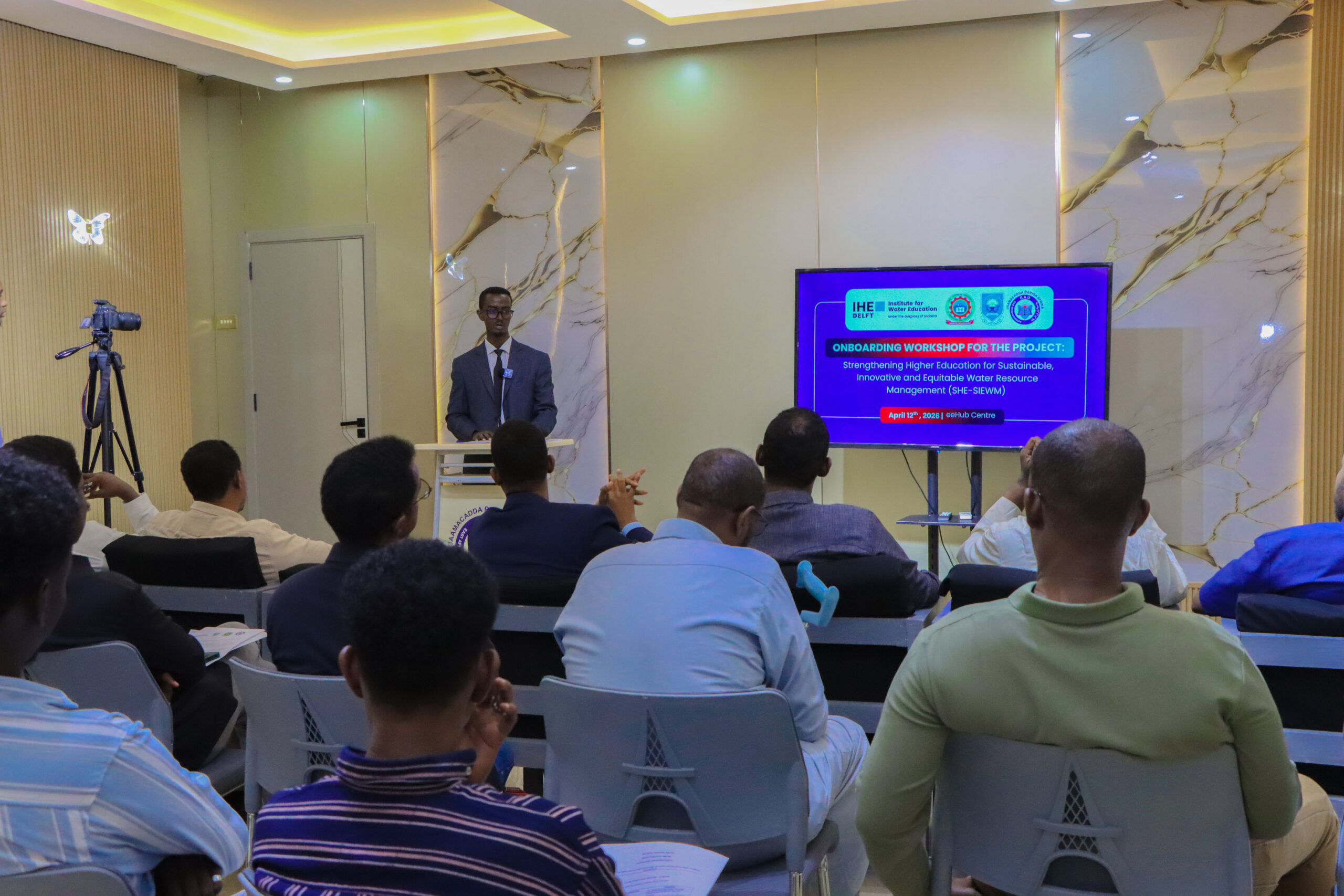
East Africa University today hosted the official launch of the Strengthening Higher Education for Sustainable, Innovative and Equitable Water Resource Management (SHE-SIEWM) project at its EE Hub in Garowe. The high-level event brought together government officials, development partners, and academic leaders in a coordinated effort to address one of the region’s most pressing challenges: sustainable water management.
The program was opened with welcome remarks from the Univeristy Director Shk. Mohamoud Haji Yusuf. The project overview was delivered by Luqman Yassen, Project Coordinator, who outlined the vision and structure of the initiative, setting the stage for a series of interventions from key government representatives and sector stakeholders.
The SHE-SIEWM project is a 36-month, multi-country initiative covering Somalia, Kenya, and Ethiopia. Led by Jimma University College of Agriculture and Veterinary Medicine, the project is implemented in partnership with IHE Delft Institute for Water Education, Jomo Kenyatta University of Agriculture and Technology, and East Africa University.
Its primary goal is to strengthen higher education systems to better respond to water-related challenges by modernizing postgraduate curricula, enhancing regional academic collaboration, and promoting practical, interdisciplinary learning.
peakers emphasized that across the Horn of Africa, water systems are under increasing pressure from climate change, population growth, and unsustainable resource use factors that continue to limit access, degrade quality, and deepen inequality, particularly in rural and marginalized communities.
A central highlight of the event was the contribution from UNICEF, represented by Mohamed Ahmed Dahir. He provided a compelling account of Somalia’s evolving water landscape, noting that while the central government has historically invested in only around 50 water wells, community-driven efforts have increased that number to over 500 across Puntland.
These systems, he explained, are increasingly managed by community-owned and business-oriented entities, ensuring more consistent water supply across cities. UNICEF has played a critical role in supporting access to safe drinking water in a context marked by low rainfall and recurrent droughts.
The organization has also invested in water quality laboratories and research initiatives examining behavioral patterns in water use, sustainability challenges, conflict over water resources, and the impact of climate shocks.
Dahir further highlighted UNICEF’s support in strengthening water information systems, improving resource management, and promoting innovative financing models. These include blended financing approaches that combine public, private, and international investments to expand water access. He also pointed to ongoing efforts to support policy development in the water sector.
Despite progress, he identified several persistent challenges: climate variability, waterborne diseases, limited technical expertise, low adoption of technology, weak public awareness, and insufficient collaboration with academic institutions. He called on East Africa University to play a transformative role in building community ownership, accountability, and knowledge around water resource management.
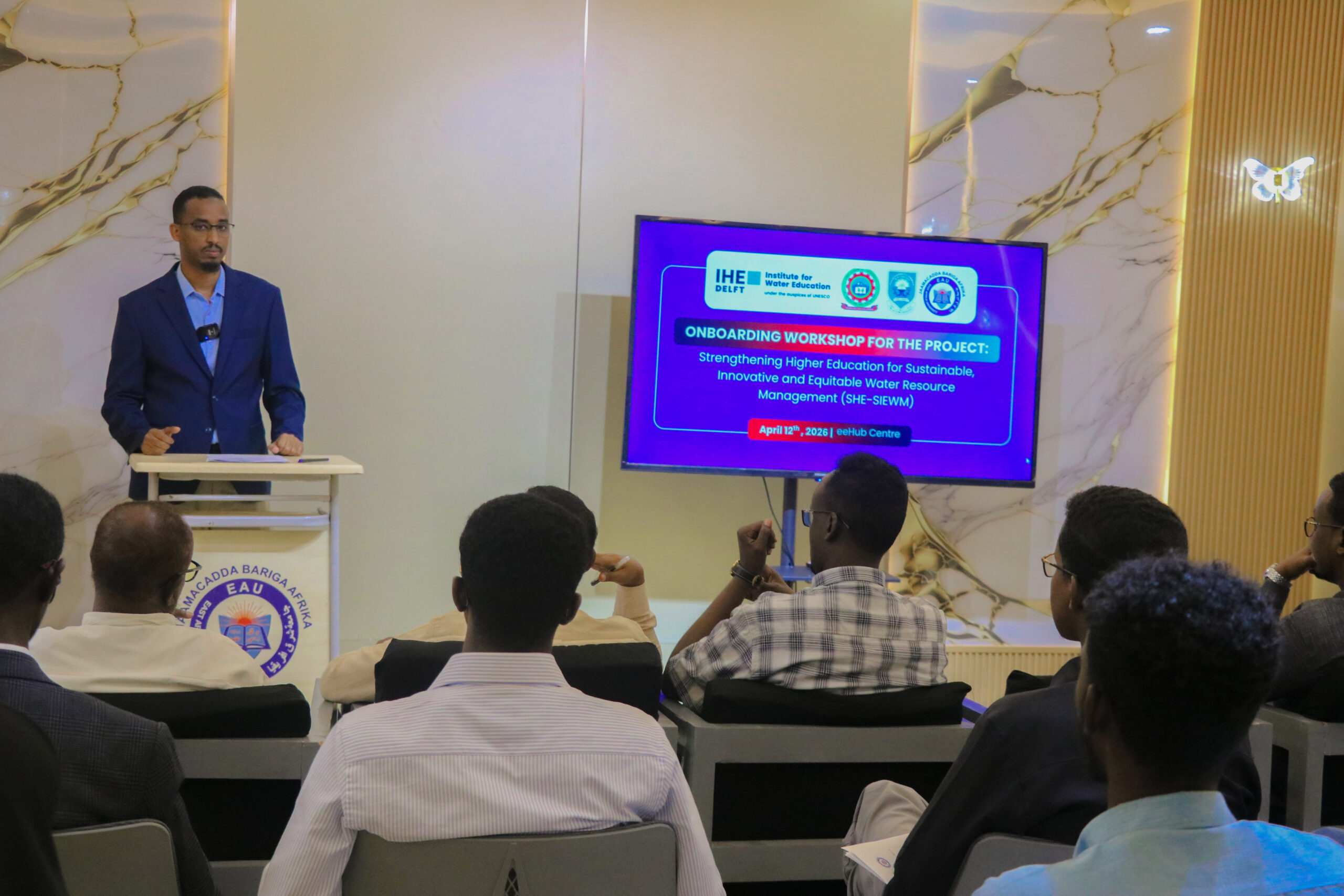
From the government side, Mohamed Isse, Technical Advisor at the Ministry of Planning Puntland, emphasized that the project is well aligned with the government’s five-year National Development Plan. He commended the university and its partners for initiating a collaborative effort to co-create a focused and relevant curriculum on water knowledge..
Similarly, Abdirahman Jama Daacad, the Director of the Higher Education Department of the Ministry of Education highlighted the importance of strengthening higher education systems to produce graduates capable of addressing national development challenges including water.
Shafici Mohamoud Ismail, Director General at the Ministry of Environment Somalia, drew attention to Somalia’s “double-edged” water crisis characterized by both severe droughts and destructive floods. He stressed that developing a strong, context-driven curriculum is essential for equipping citizens and professionals with the knowledge needed to navigate these extremes.
A recurring theme throughout the event was the need to transform higher education to better address real-world challenges. Current postgraduate programmes in water-related fields often remain highly theoretical, limiting graduates’ ability to apply their knowledge in practical contexts.
The SHE-SIEWM project aims to address this gap through curriculum reform that integrates case-based learning, stakeholder engagement, and sustainability principles. It will also introduce digital learning tools and blended teaching methods, while facilitating academic exchanges among partner institutions to promote knowledge sharing and joint research.
Stakeholder engagement is another key pillar, with government agencies, NGOs, farmers, and community representatives actively involved in shaping the curriculum to ensure relevance and impact.
The programme also featured an open reflection and discussion session, allowing participants to share insights and perspectives on water challenges and opportunities in the region. The event concluded with closing remarks from the project coordinator, followed by a networking session.
As the SHE-SIEWM project moves into implementation, East Africa University is expected to play a central role in advancing water education and fostering innovation in the sector. By linking academia, policy, and community engagement, the initiative represents a forward-looking approach to building resilience and sustainability in water resource management across the Horn of Africa.